
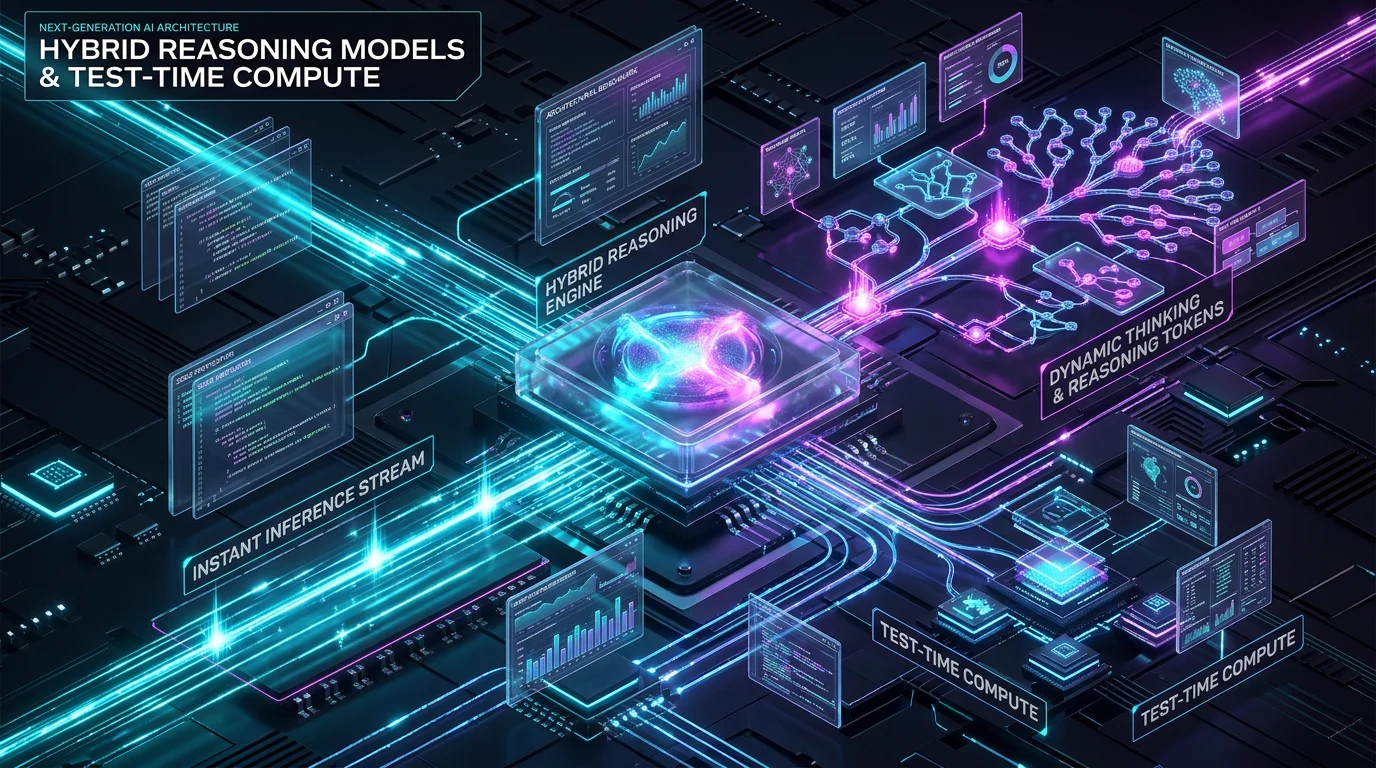
Artificial Intelligence development has entered a new phase of maturity where parameter size is no longer the sole critical metric. The true breakthrough of 2026 is Test-Time Compute (TTC) and hybrid reasoning architectures.
For years, the industry assumed that solving harder problems required trillion-parameter networks trained over months. However, frontier models such as Claude 3.7 Sonnet, OpenAI o3, and DeepSeek R1 prove that allocating dynamic compute during the exact moment of inference yields exponential improvements in formal logic, code synthesis, and systems architecture.
"The new scaling frontier no longer takes place purely in training data centers: it unfolds in milliseconds as the model evaluates hypotheses and self-corrects its thought chain before producing a single token."
What is Test-Time Compute and Dynamic Thinking?
Unlike standard autoregressive LLMs that predict tokens linearly without reflection, reasoning models generate a structured internal chain of thought (or inference search tree) prior to answering. In this phase, the model proposes hypotheses, checks for logical contradictions, prunes invalid paths, and validates syntax and mathematical constraints.
With models like Claude 3.7 Sonnet, this capability becomes controllable via API. Developers can dial a thinking budget ranging from zero tokens for sub-second responses to thousands of tokens for multi-file architectural refactors and security audits.
Technical Comparison: Claude 3.7 vs OpenAI o3 vs DeepSeek R1
- Claude 3.7 Sonnet (Dynamic Hybrid Thinking): Seamlessly toggles between instant standard responses and deep deliberate thinking through a single endpoint. Excels in large-codebase understanding, full-stack architectural design, and zero-shot test generation.
- OpenAI o3: Tailored for deep deterministic mathematics, algorithmic proofs, and structured tool orchestration with high schema conformity.
- DeepSeek R1 & Open Weights: Pioneered accessible inference-time compute using aggressive speculation and distilled reasoning checkpoints for cost-effective on-premise execution.
Impact on Modern Software Engineering
For engineering departments, hybrid reasoning transforms development lifecycles:
- Virtually Zero API Hallucinations: By verifying types and interfaces internally, integration breakage drops below 0.5%.
- Concurrency & Race Condition Debugging: The model simulates concurrent executions and deadlocks before suggesting concurrency primitives.
- Autonomous Edge-Case Coverage: Tests generated by reasoning models anticipate rare boundary conditions that human teams frequently overlook.
Cost Optimization & Intelligent Model Routing at Ingruvo
At Ingruvo, we build Intelligent Model Routing layers for high-scale enterprise platforms. Instead of blindly sending every payload to expensive reasoning engines, our gateway evaluates task complexity dynamically: simple CRUD queries route to lightweight models at minimal cost, while mission-critical business logic is escalated to hybrid reasoning engines.
Adopting test-time compute with structured orchestration delivers superior system reliability without inflating infrastructure expenses.