
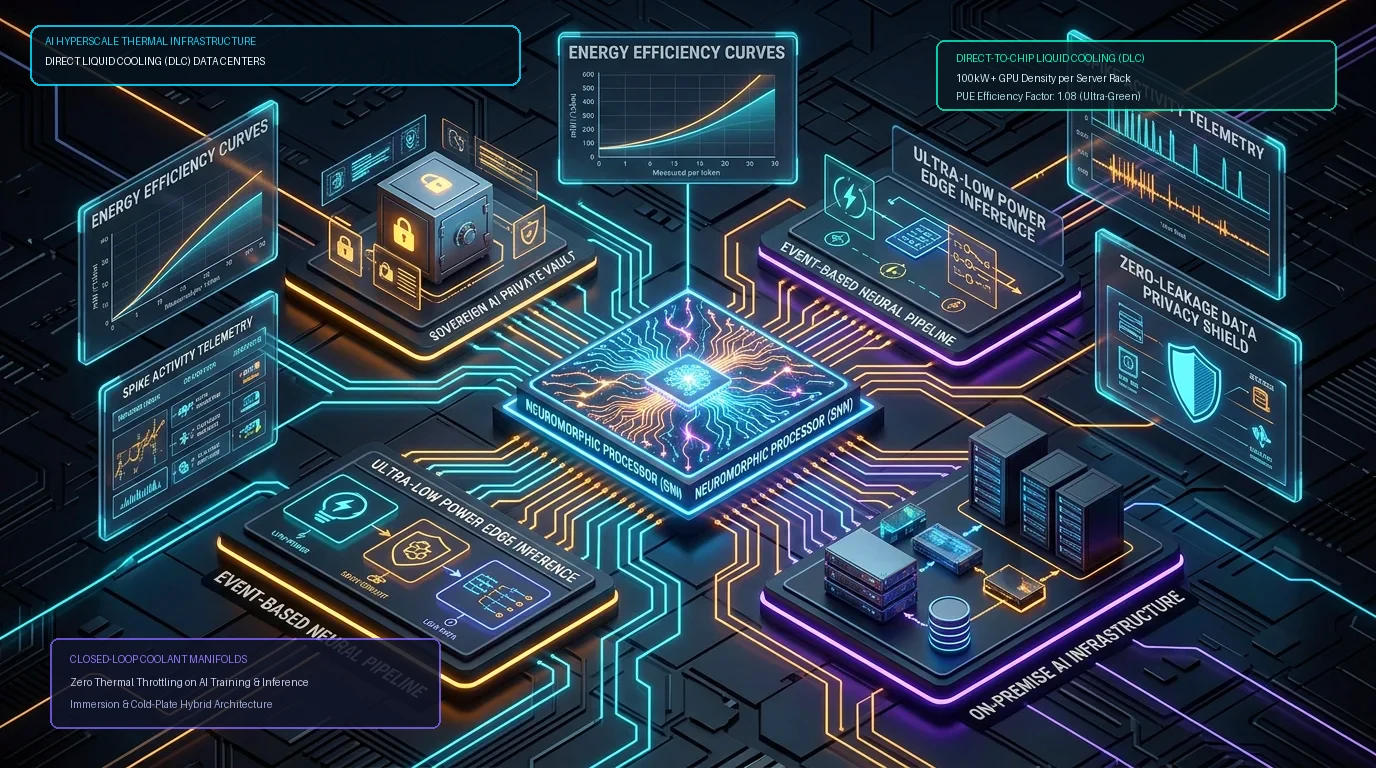
Artificial Intelligence scaling is no longer constrained solely by mathematics; it is governed by thermodynamics. With next-generation accelerator clusters (such as Nvidia Blackwell and custom hyperscaler silicon), power densities per server rack have surged beyond 100 kilowatts (kW), rendering legacy air cooling obsolete.
In 2026, hyperscale data center physical engineering is centered on Direct-to-Chip Liquid Cooling (DLC) and Immersion Cooling architectures, setting historic benchmarks in thermodynamic efficiency and unlocking dense compute clusters.
"Dielectric fluids and closed-loop liquid coolants conduct thermal energy nearly 3,000 times more effectively than air. Cooling frontier AI racks with ambient fans is no longer merely inefficient: it is physically impossible when single chips exceed 1,000 watts of thermal dissipation."
Pioneering Liquid Cooling Methodologies
- Direct-to-Chip (DLC) Cold Plates: Precision micro-machined copper cold plates bolted directly atop GPU and CPU packages. Coolant circulates through micro-channels millimeters from the silicon junction, removing heat at source.
- Coolant Distribution Units (CDUs): Regulate liquid flow rates, differential pressure, and intake temperatures across isolated closed loops with zero risk of condensation.
- Full Immersion Cooling: Entire server blades submerged in non-conductive dielectric fluids that undergo liquid-vapor phase transitions, completely abolishing mechanical chassis fans.
Thermodynamic Efficiency & PUE Optimization
- Near-Ideal PUE Metrics: While conventional air-chilled facilities struggle with PUE ratings between 1.4 and 1.6, DLC-enabled facilities consistently achieve PUE ratios of 1.05 to 1.10.
- Up to 90% Water Conservation: Closed-loop liquid configurations eliminate massive evaporative cooling towers, preserving critical regional water reservoirs.
- Waste Heat Harvesting: Effluent hot coolant (ranging from 50°C to 60°C) is recaptured to power municipal district heating systems, greenhouse agriculture, and industrial manufacturing.
Sustainable Cloud Architecture with Ingruvo
At Ingruvo, we guide enterprises toward high-efficiency, green-certified cloud and colocation infrastructure. We optimize distributed software architectures to maximize hardware compute density while minimizing digital carbon footprints.