The era of conversational proof-of-concepts and toy AI demos is officially over. In 2026, the engineering discipline that distinguishes successful AI deployments from costly failures is Agent Engineering.
Building an autonomous agent for a tech demo requires under 20 lines of scripting. But deploying production agents capable of interacting with transactional ERPs, CRM databases, and payment processors demands deterministic state control, checkpoint persistence, and rigorous Human-in-the-Loop (HITL) governance.
"Over 80% of agentic AI initiatives stall prior to production not because underlying LLMs lack reasoning, but because the software architecture lacks state machines, fault isolation, and deterministic tool constraints."
From Free Loops to Explicit State Graphs (DAGs)
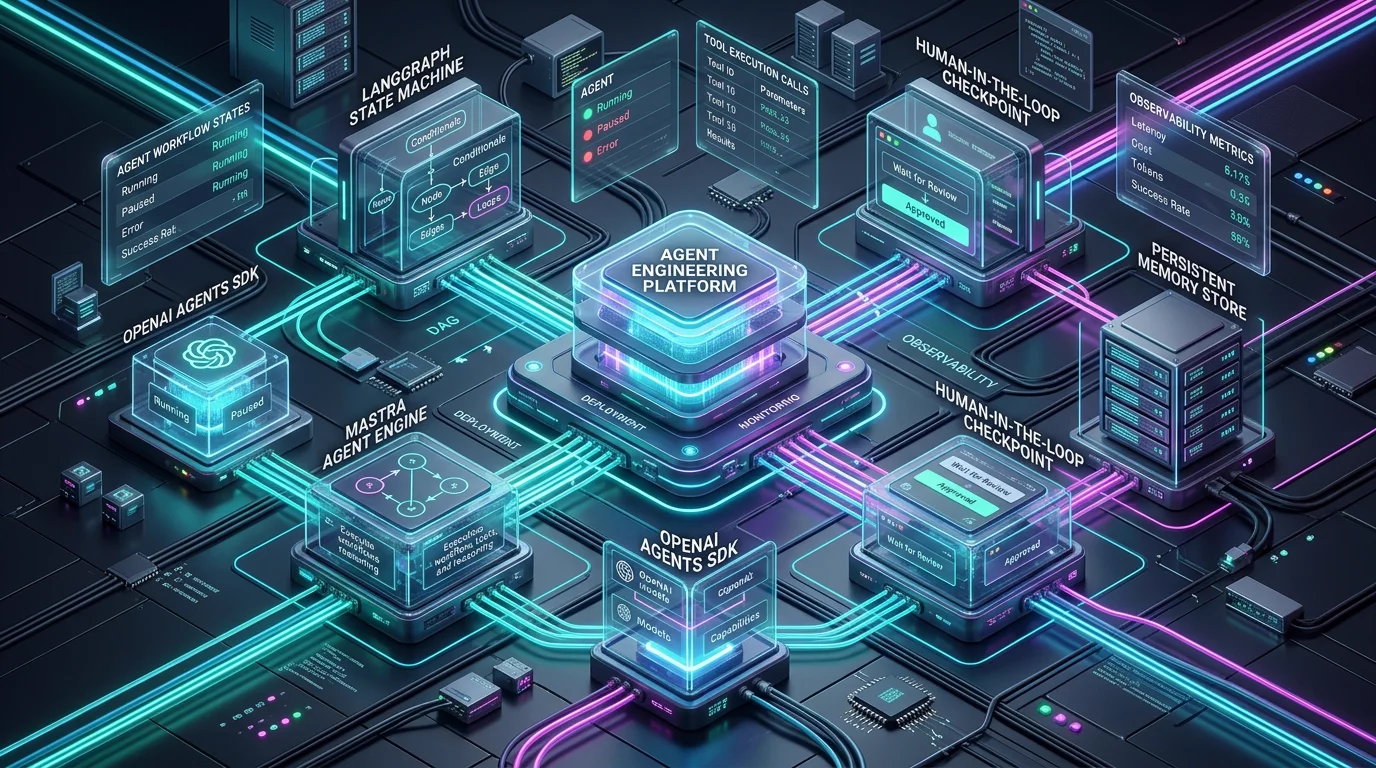
First-generation autonomous agents relied on unbounded ReAct loops that frequently degraded into recursive hallucinations or unexpected tool calls. Modern Agent Engineering is anchored in Directed Acyclic Graphs (DAGs) and Finite State Machines:
- LangGraph (Python / TypeScript): Encapsulates agent logic into explicit graph nodes and conditional branches. Every decision cycle is a fully auditable state mutation with built-in time-travel debugging.
- Mastra (TypeScript-First Framework): Purpose-built for modern full-stack engineering teams. Features end-to-end type safety, structured workflows, standardized tool execution, and seamless episodic memory stores.
- OpenAI Agents SDK / Anthropic Agent SDK: Robust primitives for tool calling, streaming multi-agent handoffs, and low-latency session persistence.
Human-in-the-Loop Checkpoints in Critical Workflows
In enterprise settings, agents must never perform irreversible state modifications without explicit confirmation. State graph frameworks allow workflows to suspend execution at a defined checkpoint stored in PostgreSQL or DynamoDB, push approval requests to human reviewers via Slack or web portals, and resume execution without losing state context.
Essential Enterprise Production Patterns
- Tool Circuit Breakers: When external downstream APIs experience high latency or 5xx errors, agents seamlessly fallback to secondary flows without burning token budgets in retry loops.
- Tiered Memory Architecture: Strict demarcation between ephemeral prompt context and indexed long-term semantic memory in pgvector stores.
- End-to-End Observability: Real-time tracing of node transitions, tool execution fidelity, latency distribution, and unit token costs.
Enterprise Agent Engineering with Ingruvo
At Ingruvo, we build high-reliability autonomous and multi-agent systems engineered for enterprise scale. From document compliance pipelines to autonomous Level-2 customer engineering agents connected via Model Context Protocol (MCP), we deliver predictable SLAs, data privacy, and full operational transparency.